

Cuba’s communist leaders are in the midst of crisis – and not for the first time.
On Oct. 18, 2024, the nation’s electrical grid failed, leaving Cubans without lights or refrigeration. Blackouts have persisted since, and as of Nov. 4 they show no sign of letting up.
These power failures form part of a larger economic crisis, the worst since 1991. Cuba burns oil to generate electricity and, put simply, it cannot pay for the oil it needs, much less maintain the electric system. This has led to severe shortages not only of electricity but also gasoline, food and medical supplies.
Cuba’s latest crisis has led observers to question the regime’s viability, with many asking whether now could be the time for Cuba’s communist government either to reform or collapse.
To a scholar of Cuban history like myself, it’s a fair question. Cuba’s leaders have endured similar crises for more than six decades – maintaining a monopoly on political power throughout. The reason lies less in ideological commitment than in the ability of Havana’s leaders to become the clients of powerful foreign patrons. Cuba’s communists have also proven willing to reverse course when their survival demands it.
This time, however, it is not clear that either strategy will be sufficient for the heirs of Fidel Castro to preserve their power.
Trading sovereignty for prosperity
Historically, Cuba has achieved a measure of prosperity by forging trading relationships with powerful nations.
These dealings have often taken the form of “patron-client” relationships, in which a powerful nation has propped up the Caribbean nation’s economy but infringed on Cuba’s sovereignty in the process.
From 1898 to 1959, Cubans sold sugar in the U.S. under a quota system somewhat favorable to Havana. In exchange, Americans built bases on Cuban soil and sold their goods in Cuba with minimal constraints, while maintaining a right to intervene in Cuba’s politics.
But after the Cuban Revolution ended in 1959, the United States severed diplomatic and economic ties with the new regime, and the Soviet Union became Cuba’s patron.
Decades of Soviet support
For 30 years, Moscow bought Cuban sugar at inflated prices and sold Russian oil at below market prices, while equipping Cuba’s armed forces. These subsidies amounted to more than US$4 billion per year in the 1980s.
In return, Cuba’s leaders permitted Soviet bases on their soil, conveniently less than 100 miles from Florida, and supported Soviet foreign policy objectives, such as the invasions of Czechoslovakia in 1968 and Afghanistan in 1979.
In 1991, however, the Soviet Union collapsed. Without Soviet subsidies, Cuba went into an economic tailspin.
A ‘Special Period’?
Between 1991 and 1993, Cuba lost one third of its GDP.
Food, gasoline and electricity became scarce. Public transportation largely disappeared, replaced by horses, bikes and motorcycle taxis.
Longtime dictator Fidel Castro referred to the era as the “Special Period in time of Peace.” But I know Cubans who remember the 1990s as a time of eating beans, rice and grapefruit peels when they were lucky, sugared water when they were not.
It was oil-rich Venezuela that brought Cuba out of the Special Period. In 1999, a regime friendly to Castro took power in Caracas, headed by military leader Hugo Chavez. Chavez provided oil to Cuba in exchange for doctors, teachers and advisers for his military and security forces.
Unlike the U.S. and Soviet Union, Venezuela had no reason to compromise Cuba’s sovereignty; the two nations already had common allies and adversaries.
In 2015, a Cuban economist told me that Venezuela’s subsidies amounted to at least $4 billion per year.
Following Chavez’s death in 2013, however, Venezuela entered an economic crisis even worse than Cuba’s – the result of unprecedented mismanagement, overreliance on petroleum sales and the impact of U.S. sanctions. Chavez’s subsidies slowed to a trickle by 2019 and have yet to return.
After a brief respite, the U.S. reimposed sanctions on Venezuela in 2024 as President Nicolás Maduro reneged on his promise to hold free and fair elections. Venezuela now sells oil to middlemen while supplying Cuba with petroleum in secret, in amounts and quality far below Cuba’s need.
The consequence has been the deepening of Cuba’s economic decline.
Since 2020, the Cuban GDP has shrunk, as has tourism. Inflation runs rampant in both official and “gray markets,” private networks that operate outside of official sanction and charge higher prices.
Havana changes when it needs to
Without an obvious new patron to prop up its economy, Cuba’s leaders have had to turn to other tactics to relieve the pressure – or tamp it down.
But coercion has always played a role central to the Cuban government’s survival.
Though the regime allows Cubans to complain in public, they cannot agitate for political change without receiving harsh treatment. For example, the government has threatened opponents with prosecution if they organize protests during the current crisis.
In other respects, however, the regime has changed when its survival requires it to do so. This can be seen in the growth of private enterprise in the officially communist country. Until the 2000s, Cubans worked for the state and held only negligible amounts of wealth.
But limited economic privatization beginning in 2008 has meant that today one-third of all Cubans make their living in the private sector, up from 23% in 2020.
The growth of Cuba’s private sector lessens demands on an already underresourced public sector, while allowing for a greater circulation of goods and services – and much-needed hard currency.
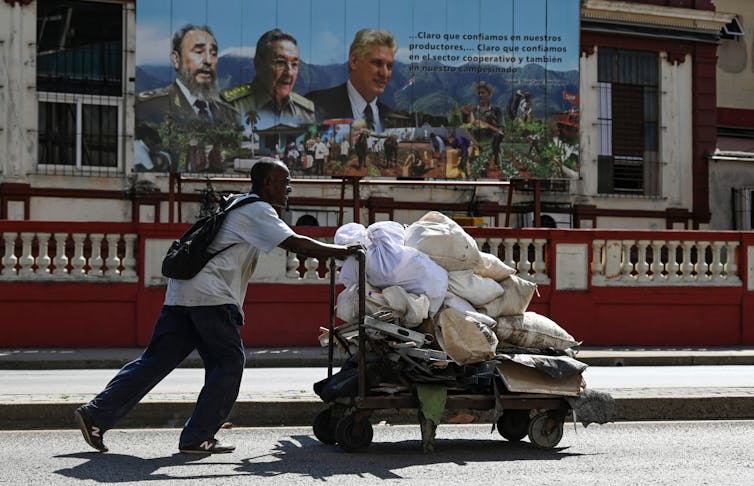
But by far, the Cuban government’s biggest change concerns emigration. Since the 1960s, the communist government condemned Cubans who left as “worms,” or enemies of the revolution.
Now, the government allows Cubans to leave with little to no interference.
More than a million Cubans have emigrated since 2022, about 10% of the population. The U.S. remains their top destination, along with Spain and other Spanish-speaking countries.
Cubans who reach the U.S. can apply for parole at the U.S. border and live in the United States – with a work permit – if they have American sponsors. After one year, they qualify for residency.
U.S. policy eases Cuba’s problems
Emigration means fewer demands on public services and scarce resources, such as food and electricity.
It also eases a critical housing shortage, making more housing available at more affordable prices to the Cubans who stay.
Emigration also means fewer Cubans in Cuba with the energy to organize for political change.
And having more Cubans overseas can help the home economy, with those in higher-wage countries able to send hard currency back to their relatives and friends – who will in turn spend the cash in Cuba.
Can Cuba’s government hold out?
Cuba’s leaders have changed when they felt compelled to do so. As to whether the easing of private sector and immigration restrictions will buy them enough time to find another patron, however, is anyone’s guess.
China and Russia may choose to become patrons of Cuba, in part as a way to get a foothold in a nation so close to the U.S.
Both countries reportedly have increased levels of investment in Cuba, while receiving some economic privileges and bases in return.
But it is unclear whether China and Russia will be willing to provide the billions of dollars in subsidies the Cuban government needs.
China, for example, has other more profitable investment options in Latin America. And stuck in a war of its own making, Russia has little spare military forces or cash.
Whatever the case, Cuba needs to find a solution to its current crisis. If a patron is not forthcoming, the Cuban government may face more difficult choices, such as increasing repression or permitting both economic and political liberalization.
And that is a choice Cuba’s leaders would like to avoid.